

 Facebook
 Instagram
Supporting Muscle Health Through All Life Stages
By Caitlin Beale, MS, RDN+
Muscle health is often considered through the lens of building bigger, stronger muscles, but preserving muscle is equally important. Muscle loss has long been a concern with aging and weight loss, but with the rise in interest in healthy longevity and the increased use of weight loss medication or undergoing rapid weight loss, the conversation has moved front and center.1 2
Muscle plays a central role in movement and balance, helping support mobility and physical independence. As a result, conversations around healthy aging and weight management should center not just on weight loss but on maintaining muscle throughout the process.
Resistance training and nutrition both play important roles in supporting muscle health through different stages of life.
Why Muscle Preservation Matters
Muscle supports far more than strength or exercise performance. Healthy muscle tissue is essential for balance, joint stability, and overall physical function. Research also links muscle health to greater independence and quality of life across the lifespan.3
Aging and Muscle Loss
Adults gradually lose muscle mass and strength with age. Age-related muscle loss is associated with reduced mobility, increased risk of falls, and frailty in older adults.1
But muscle loss doesn’t have to be inevitable. Research suggests that exercise, particularly resistance training, can help slow muscle loss and support strength and function. Along with regular movement, nutrition provides the key nutrients needed to support muscle maintenance and recovery.4
Muscle Preservation and Weight Loss Medications
Weight loss isn’t driven only by loss of fat mass. Research shows that reductions in lean body mass commonly occur along with fat loss during weight-loss interventions. Since GLP-1 medications often lead to substantial, rapid weight loss, preserving muscle mass is an important focus.2
A 2024 review found that changes in lean mass during GLP-1-related weight loss vary, but reductions in muscle mass can account for a significant portion of the total weight lost.5
Preserving lean muscle while losing weight is essential, as muscle strength is closely tied to mobility and physical function6

Nutrients That Support Muscle Health
Muscle maintenance depends on multiple factors, including exercise and nutrition. The following nutrients may support muscle function and strength alongside resistance training.
Protein
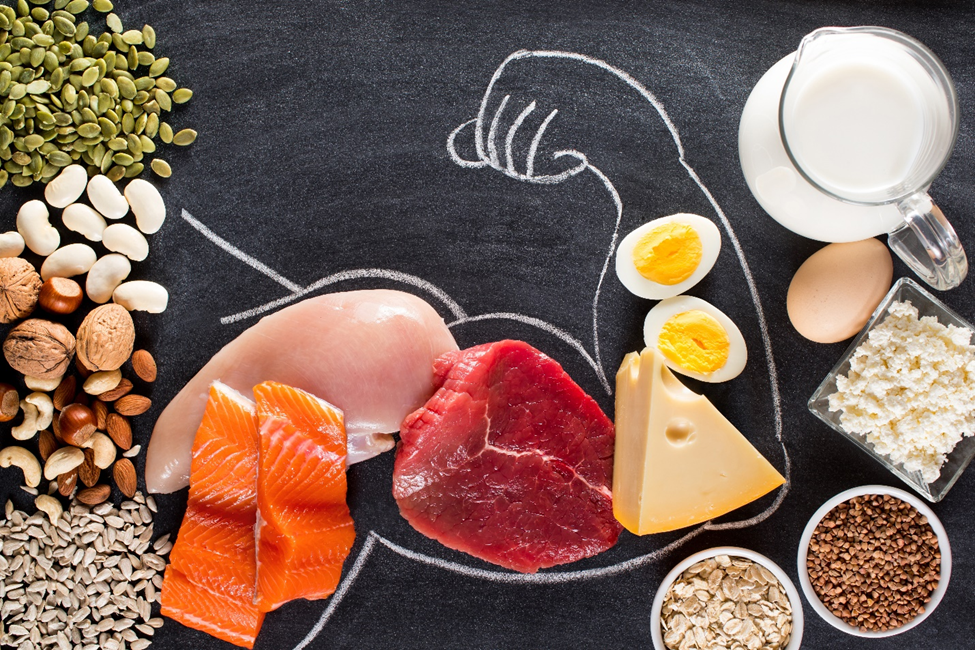
Protein is one of the most important nutrients for muscle health because it provides the amino acids needed to build, repair, and maintain muscle tissue. Research also shows that adequate protein intake becomes increasingly important during aging, weight loss, and periods of physical training or recovery.7 8
Protein-rich foods include Greek yogurt, eggs, fish, poultry, beans, lentils, and tofu. Protein supplements can also help fill nutritional gaps if you have increased needs or have trouble eating enough.8
Calcium
Calcium is best known for its role in supporting healthy bones, but it is also essential for normal muscle function.9 Muscle contractions depend on calcium to help muscles contract and relax properly.10
Research suggests that the close relationship between muscle and bones becomes increasingly important with aging, when changes in both muscle and bone tissue can affect balance and strength.11
Calcium-rich foods include dairy products, fortified plant milks, sardines, tofu made with calcium sulfate, and leafy greens.12 Supplements can also help fill gaps, which may be especially helpful for those following a plant-based diet or whose daily needs increase with age.13
Magnesium
Magnesium is found in foods like nuts, seeds, legumes, leafy greens, and whole grains.14
Magnesium plays an important role in normal muscle function. It also serves as a cofactor in hundreds of enzymatic reactions involved in energy production and muscle performance.15
Low magnesium intake may adversely affect muscle performance and strength, especially in older adults.15 Daily requirements can vary with factors such as activity level and overall health status.16
Vitamin D
Vitamin D contributes to normal muscle function, strength, and physical performance. Research has also linked low vitamin D levels to reduced physical performance and an increased risk of functional decline in older adults.17
Sunlight and supplements are the primary sources of vitamin D for most people, since dietary sources are limited to fatty fish, egg yolks, and small amounts in fortified dairy products and plant-based beverages.18 Individual needs can differ based on age, skin tone, location, and outdoor sun exposure.18
Creatine
Creatine is one of the most researched supplements for muscle health and exercise performance. It helps support the body’s ability to rapidly produce energy during short bursts of high-intensity activity such as resistance training.19
Research suggests that supplementing with 3 grams of creatine daily may help support muscle strength and physical performance in older adults aged 55 and older when combined with moderate-to-high-intensity resistance training.20
Muscle Health is A Lifelong Investment
Muscle preservation is essential to healthy aging and weight management. While some changes in muscle mass naturally occur over time, daily habits can affect how well muscle strength and function are maintained.
Regular resistance training, adequate protein intake, and nutrient-dense foods that provide key nutrients for muscle health and recovery are important. Evidence-based supplements may also help fill nutritional gaps when dietary intake or needs change.
Always consult with your provider before starting a new exercise program or adding supplements to ensure they are safe for your individual needs.
Caitlin Beale, MS, RDN is a registered dietitian and freelance health writer. She has a master’s degree in nutrition and over ten years of experience as a registered dietitian.
+The views expressed in this article are those of the authors. They do not reflect the opinions or views of Pure Encapsulations®.
References
- Arnold WD, Padilla Colón CJ. Maintaining muscle function across the lifespan: the state of science. Am J Phys Med Rehabil. 2020;99(12):1171-1176. doi:10.1097/PHM.0000000000001429vvv
- Ceasovschih A, Asaftei A, Lupo MG, et al. Glucagon-like peptide-1 receptor agonists and muscle mass effects. Pharmacological Research. 2025;220:107927. doi:10.1016/j.phrs.2025.107927
- Tøien T, Berg OK, Modena R, Brobakken MF, Wang E. Heavy strength training in older adults: implications for health, disease and physical performance. J cachexia sarcopenia muscle. 2025;16(2):e13804. doi:10.1002/jcsm.13804
- Distefano G, Goodpaster BH. Effects of exercise and aging on skeletal muscle. Cold Spring Harb Perspect Med. 2018;8(3):a029785. doi:10.1101/cshperspect.a029785
- Prado CM, Phillips SM, Gonzalez MC, Heymsfield SB. Muscle matters: the effects of medically induced weight loss on skeletal muscle. The Lancet Diabetes & Endocrinology. 2024;12(11):785-787. doi:10.1016/S2213-8587(24)00272-9
- Rossi G, Bucciarelli L, Mananguite CL, Giovarelli M, Fiorina P. Muscle loss and GLP-1R agonists use. Acta Diabetol. 2025;63(2):333-342. doi:10.1007/s00592-025-02611-2
- Nunes EA, Colenso‐Semple L, McKellar SR, et al. Systematic review and meta‐analysis of protein intake to support muscle mass and function in healthy adults. J cachexia sarcopenia muscle. 2022;13(2):795-810. doi:10.1002/jcsm.12922
- Carbone JW, Pasiakos SM. Dietary protein and muscle mass: translating science to application and health benefit. Nutrients. 2019;11(5):1136. doi:10.3390/nu11051136
- Mosqueira M, Brinkmeier H, Jaimovich E. Editorial: calcium homeostasis in skeletal muscle function, plasticity, and disease. Front Physiol. 2021;12:671292. doi:10.3389/fphys.2021.671292
- Kuo IY, Ehrlich BE. Signaling in muscle contraction. Cold Spring Harb Perspect Biol. 2015;7(2):a006023. doi:10.1101/cshperspect.a006023
- Caffarelli C, Al Refaie A, Mondillo C, et al. Influence of dietary calcium intake on skeletal health and body composition in an italian elderly population. Nutrients. 2025;17(13):2073. doi:10.3390/nu17132073
- Office of dietary supplements – calcium. Accessed May 26, 2026. https://ods.od.nih.gov/factsheets/Calcium-HealthProfessional/
- Kim YS, Hong KW, Han K, et al. Longitudinal observation of muscle mass over 10 years according to serum calcium levels and calcium intake among korean adults aged 50 and older: the korean genome and epidemiology study. Nutrients. 2020;12(9):2856. doi:10.3390/nu12092856
- Office of dietary supplements – magnesium. Accessed May 26, 2026. https://ods.od.nih.gov/factsheets/Magnesium-HealthProfessional/
- Liguori S, Moretti A, Paoletta M, Gimigliano F, Iolascon G. Role of magnesium in skeletal muscle health and neuromuscular diseases: a scoping review. IJMS. 2024;25(20):11220. doi:10.3390/ijms252011220
- Zhang Y, Xun P, Wang R, Mao L, He K. Can magnesium enhance exercise performance? Nutrients. 2017;9(9):946. doi:10.3390/nu9090946
- Yoon S, Kwon O, Kim J. Vitamin D in athletes: focus on physical performance and musculoskeletal injuries. Phys Act Nutr. 2021;25(2):20-25. doi:10.20463/pan.2021.0011
- Office of dietary supplements – vitamin d. Accessed May 26, 2026. https://ods.od.nih.gov/factsheets/VitaminD-HealthProfessional/
- Kreider RB, Jagim AR, Antonio J, et al. Creatine supplementation is safe, beneficial throughout the lifespan, and should not be restricted. Front Nutr. 2025;12:1578564. doi:10.3389/fnut.2025.1578564
- Bonilla DA, Stout JR, Candow DG, et al. The power of creatine plus resistance training for healthy aging: enhancing physical vitality and cognitive function. Front Physiol. 2024;15:1496544. doi:10.3389/fphys.2024.1496544